How to Build a Reading Corner You’ll Actually Use
A good reading corner is less about styling a perfect photograph and more about removing the small frictions that make it easy to abandon a book after ten minutes. The chair should support the way you actually sit, the light should fall where you need it, and the things you reach for should already be close by. That can happen in a generous bay window, but it can also happen in a narrow bedroom corner or beside a shelf in a studio flat.
Start by choosing a place that already feels slightly separate from the busiest part of the room. A corner beside a window often works well because daylight gives the area a natural sense of purpose. If the only available spot is away from a window, that is not a problem; it simply makes the lighting plan more important.
Begin with the chair, not the accessories
The most attractive chair is not necessarily the best reading chair. Sit in it for fifteen minutes before deciding. Your feet should either rest comfortably on the floor or have somewhere to go, and your shoulders should not be pushed forward by an overly deep back. If the seat is deep, a small cushion behind the lower back can make a dramatic difference.
Armchairs are an obvious choice, but a compact dining chair with a supportive back can work in very small rooms. A bench against a wall can also become comfortable with a firm seat pad and one or two cushions. The goal is to create a position you can maintain without constantly shifting.
Light the page, not the whole room
Ambient light makes a room pleasant, while task light makes reading easy. A floor lamp placed just behind one shoulder is often more useful than a bright ceiling light. Aim the lamp so that the page is evenly illuminated without glare. If you usually read in the evening, a warm bulb can feel calmer than a cool, blue-white one.
Window light is ideal during the day, but think about how it changes over several hours. Direct late-afternoon sun can be uncomfortable, while a sheer curtain can soften it without making the corner gloomy. If reflections are an issue on glossy pages or an e-reader, moving the chair by only a few degrees may solve the problem.
Keep the essentials within one reach
A small side table is often more useful than another shelf. It gives you somewhere to put a mug, glasses, a notebook, or the book you plan to pick up next. In a tight space, a narrow stool or wall-mounted ledge can do the same job with a much smaller footprint.
Try to keep the surface mostly clear. A reading corner becomes less relaxing if every session begins with moving piles of unrelated objects. One coaster, a small lamp, and room for a book are usually enough.
Let the books stay visible, but not crowded
You do not need to move an entire collection into the corner. A short shelf of current and next-up books can be more useful than a densely packed wall. It also makes the area feel active: the books nearby are the ones you are genuinely interested in now.
If there is no room for shelving, a neat stack on a side table or a shallow basket beside the chair works well. Keep stacks low enough that they remain easy to browse rather than becoming furniture.
Add comfort in layers
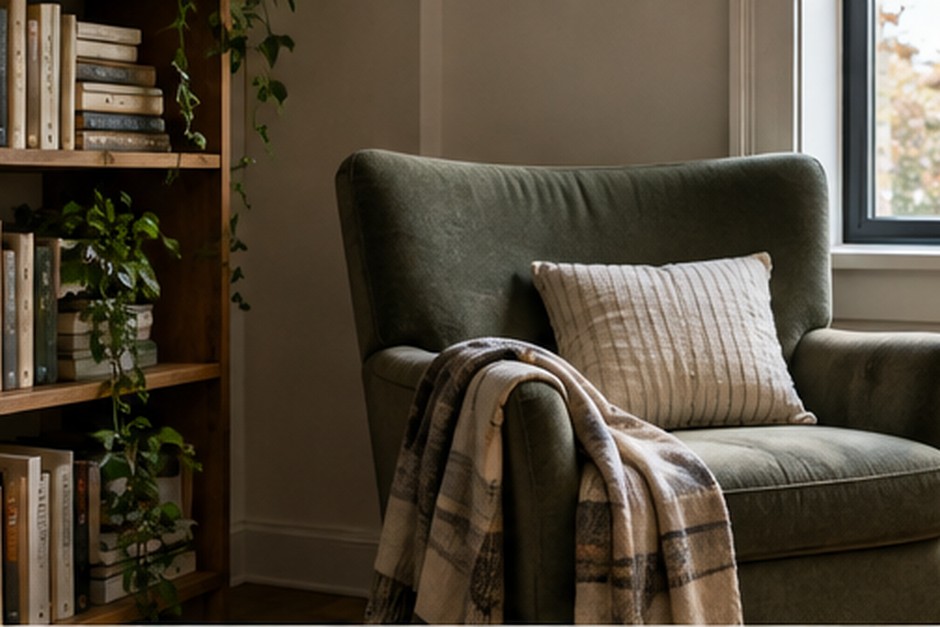
A throw is useful because body temperature often drops during longer periods of sitting. Choose one that is easy to wash and large enough to cover your legs without constant adjustment. A rug can make a corner feel visually contained, particularly in open-plan rooms, but it is optional. The chair, light, and nearby surface matter much more.
Plants, framed prints, and decorative objects can add personality, but add them after the functional pieces are working. A reading corner should still feel calm when the objects are removed. If it only feels complete when every surface is styled, it may be doing more decorative work than practical work.
Make the corner easy to return to
The final step is behavioural rather than decorative. Leave the current book where you can see it. Keep the lamp switch easy to reach. Put the blanket back on the chair instead of storing it elsewhere. These small choices reduce the effort required to begin reading.
After a week, notice what you keep adjusting. Perhaps the lamp is too low, the side table is on the wrong side, or the chair needs a firmer cushion. A reading corner becomes genuinely useful through these small corrections. Once the setup suits your habits, even a modest patch of floor can become one of the most frequently used places in the home.